
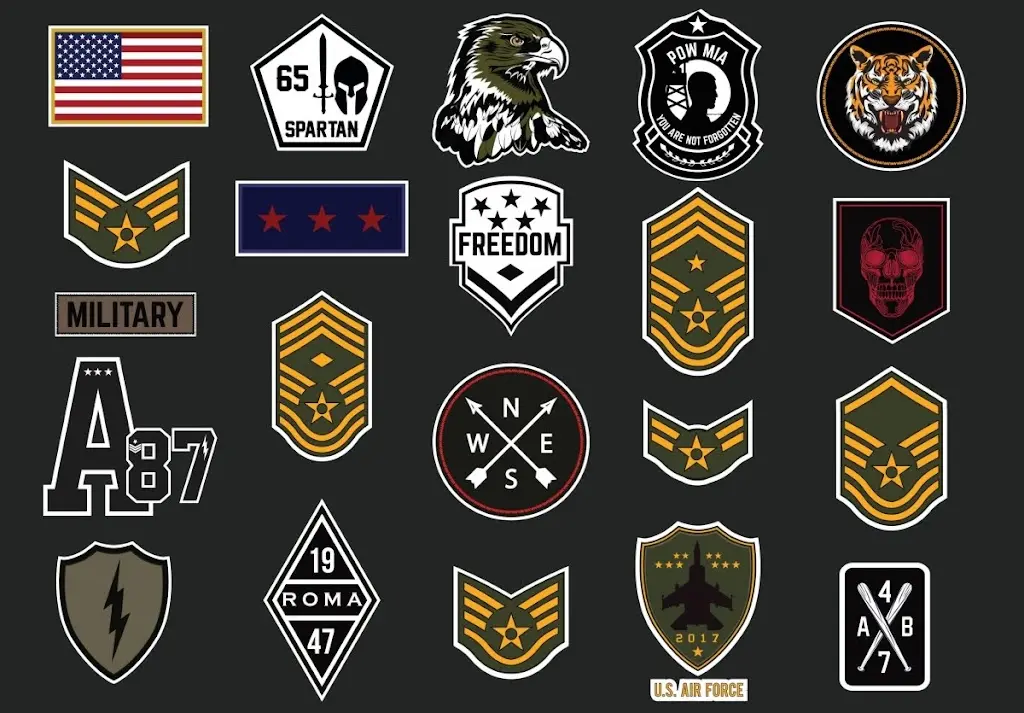
Military patches tell a story and identify branch, command, unit, and specialization at a glance. For new service members, collectors, or family members, distinguishing between Air Force, Army, and other branch patches can be confusing at first. Shapes, colors, abbreviations, and placement rules can vary widely, and two patches may look similar while representing completely different meanings.
Our comprehensive guide to understanding and identifying the most common U.S. military patches can help you prepare a uniform, build a collection, or simply try to learn what a patch represents.
Understanding the Main Types of Military Patches
While every branch has its own patch culture and standards, most patches fall into a few major categories. Learning these first makes identification much easier.
Command Patches
Command patches are designed to identify a major command, division, wing, fleet, or large organizational structure. These patches often have bold, recognizable symbols and are worn to show what “big picture” organization the service member belongs to.
For example, in the Air Force, major commands (MAJCOMs) frequently use command-level emblems. In the Army, large units like divisions and corps use distinctive shoulder sleeve insignia (SSI).
Unit Patches
Unit patches identify a specific unit within a branch. This could be a battalion, regiment, wing, group, or similar structure. Unit patches often carry lineage and heritage, meaning they can reflect decades (or centuries) of history.
Unit patches may include:
- A unit nickname or motto
- A shield, torch, sword, eagle, or star
- Colors associated with the unit’s tradition
- References to historical campaigns
Squadron Patches
Squadron patches are especially common in the U.S. Air Force and are one of the easiest patch types to recognize. They are typically highly detailed, featuring aviation themes like aircraft silhouettes, lightning bolts, wings, bombs, or stylized animals.
Squadron patches are often more creative than other patch categories, which is why collectors frequently gravitate toward them.
Specialty Patches
Specialty patches identify a job function, qualification, or role. These are often used to represent a skill set, such as:
- Medical units
- Explosive ordnance disposal
- Aviation maintenance
- Intelligence and surveillance roles
- Search and rescue
Depending on the branch and uniform type, specialty insignia may appear as embroidered patches, subdued versions, or badges.
Morale Patches
Morale patches are unofficial patches designed to build camaraderie, celebrate a deployment, or reflect unit culture. They are popular in many communities, especially on flight suits and tactical gear, but they are not always authorized for every uniform.
Collectors often love morale patches because they can be humorous, artistic, and unique, but it’s important to remember that “cool” does not always mean “regulation.”
USAF Patch Identifiers and Design Characteristics
Air Force patches are among the most recognizable due to their distinctive style and the strong tradition of squadron and wing emblems.
Common USAF Patch Shapes
Most Air Force patches fall into a few shapes:
- Circular: Common for squadron patches
- Shield: Common for official heraldry and command emblems
- Oval: Sometimes used for specific groups or functions
Collectors often associate circular patches with the USAF because they are heavily used in aviation communities.
Visual Themes in Air Force Patches
USAF patches frequently feature:
- Wings and aircraft silhouettes
- Lightning bolts (communications, power, speed, air dominance)
- Globes (global operations, strategic missions)
- Stars (space operations, excellence, heritage)
- Animals (mascots symbolizing unit personality)
Air Force designs also tend to be more illustrative and “patch-art” driven than Army patches, which often focus on clean symbolism and heraldic structure.
Text, Nicknames, and Mottos
Air Force patches commonly include:
- Squadron number (e.g., “34 FS”)
- Unit nickname
- Latin mottos or mission slogans
- Base location or command references
If you see a patch with a strong aviation theme, a squadron number, and a circular format, it’s often a good clue you’re looking at a USAF squadron patch.
It’s also helpful to note that the USAF Academy and Air National Guard have their own patches.
Subdued vs. Full Color Air Force Patches
Like other branches, the Air Force uses subdued patches in tactical environments. These may appear in OCP-compatible colors (including brown/tan/green palettes) and with simplified embroidery.
Key Army Patch Distinctions (SSI, Combat Patches, and More)
The Army patch system is highly standardized and rooted in formal unit structure. If Air Force patches are known for creativity, Army patches are known for tradition and consistency.
SSI: Shoulder Sleeve Insignia
The Shoulder Sleeve Insignia (SSI) is the primary unit patch worn on the Army combat uniform. It identifies the soldier’s current major unit assignment.
SSI patches are often:
- Shield-shaped
- Simple, bold, and symbolic
- Easily recognizable at a distance
These patches represent major organizations such as divisions, corps, or separate brigades.
Combat Patches (SSI-FWTS)
One of the most distinctive Army patch traditions is the combat patch. The combat patch is formally known as the SSI-FWTS (Shoulder Sleeve Insignia – Former Wartime Service).
This patch is worn on the opposite shoulder from the current unit patch and indicates a soldier’s service in a combat zone with that unit. This is one of the biggest reasons Army patch identification can become confusing for new soldiers and family members.
Why Army Patches Often Look More “Heraldic”
Army patches frequently resemble coats of arms, shields, and traditional insignia. This style reflects the Army’s long-standing heraldic traditions and emphasis on formal lineage.
Navy and Marine Corps Patch Differences
While the Air Force and Army are patch-heavy on standard uniforms, the Navy and Marine Corps can look different depending on the uniform type and community.
Navy Patches
Navy patches are common in aviation and shipboard communities, especially on:
- Flight suits
- Coveralls
- Jackets and command gear
They often include:
- Anchors
- Ships, aircraft, or naval wings
- Squadron identifiers (similar to the Air Force)
- Command crests
Aviation-focused Navy patches can resemble Air Force patches in style, but Navy themes tend to include maritime imagery more prominently.
Marine Corps Patches
The Marine Corps traditionally uses fewer decorative unit patches on standard uniforms compared to other branches. However, Marine patches are still common on:
- Flight suits
- Specialized gear
- Deployment or training items
Marine Corps imagery often features:
- The Eagle, Globe, and Anchor (EGA)
- Aggressive symbolism tied to combat identity
- Clean, bold designs
In general, Marine patches often lean toward sharp, mission-focused symbolism rather than playful squadron-style artwork.
Placement Standards: Where Patches Go (and Why It Matters)
Even a perfectly made patch can become “wrong” if it’s worn incorrectly. Placement standards vary by branch and uniform type, but a few principles apply across the board.
Common Placement Zones
Most standard uniforms include patch placement areas for:
- Left sleeve: current unit or command
- Right sleeve: U.S. flag, former wartime service, or special identifiers
- Chest: name tapes, branch tape, qualification patches
- Shoulders: rank or additional identifiers (depending on uniform)
Why Placement Is Not Optional
Patch placement isn’t just about appearance. It’s about:
- Immediate identification
- Uniformity across the unit
- Respect for tradition
- Regulation compliance
If you’re building a collection or assembling a uniform display, accurate placement is a big part of honoring what the patch represents.
Preserve Tradition With Accurate Patch Designs
Military patches are more than fabric and thread. They preserve history, represent unit pride, and communicate service identity instantly. Understanding military patches helps preserve tradition and ensures accuracy in uniform presentation, whether you’re a new service member learning the basics, a family member trying to understand what a loved one wears, or a collector building a meaningful archive.
When accuracy matters, it’s important to rely on a trusted source. RAMA WORLD is a woman-owned company with nearly 60 years of experience delivering authentic, American-made military patches. With super quick delivery times, dependable quality, and deep expertise in military specifications, RAMA WORLD is the reliable choice for patches that meet the standard — and honor the story each patch is meant to tell.
Reach out to discuss a custom order or buy patches online today!